

TL;DR
Teaching yourself SEO is entirely achievable by focusing on four key areas. First, grasp the fundamentals of how search engines like Google discover and rank content. Next, master the four pillars of SEO: technical, on-page, content, and off-page optimization. The most crucial step is to apply your knowledge by practicing on your own website. Finally, commit to continuous learning to stay updated with the ever-evolving industry changes.
Understanding SEO Fundamentals and How Search Engines Work
Before diving into specific tactics, it's essential to understand what Search Engine Optimization (SEO) truly is. At its core, SEO is the practice of optimizing your website to improve its visibility in organic (non-paid) search engine results. When you perform well in search, you attract more relevant traffic to your site. The great news is that SEO can absolutely be self-taught, thanks to a wealth of high-quality resources available online, including guides from search engines themselves.
Search engines like Google operate on a sophisticated three-step process: crawling, indexing, and ranking. First, they use automated programs called “crawlers” or “spiders” to travel across the web, following links to discover new and updated pages. This discovery phase is known as crawling. Once a page is found, the search engine analyzes its content—text, images, and video files—to understand what the page is about. This process of storing and organizing the information is called indexing.
Finally, when a user types a query, the search engine sifts through its massive index to find the most relevant and high-quality results. This is ranking. Google uses hundreds of signals to determine which pages best answer a user's query. A helpful way to visualize the key components of SEO comes from an analogy shared in a popular SEO guide from Mangools: think of it as a soup. The technical health of your site is the bowl holding everything together, your content is the nourishing soup itself, and backlinks are the seasoning that adds authority and flavor.
To begin, it's important to build a solid foundation. This means ensuring your website is technically sound so search engines can easily access and understand it. A simple, practical first step you can take is to check if your site is indexed by Google. You can do this by using the `site:` search operator in Google (for example, `site:yourwebsite.com`). If results appear, Google has found and indexed at least some of your pages, which is a great starting point for your SEO journey.
The Four Pillars of a Successful SEO Strategy
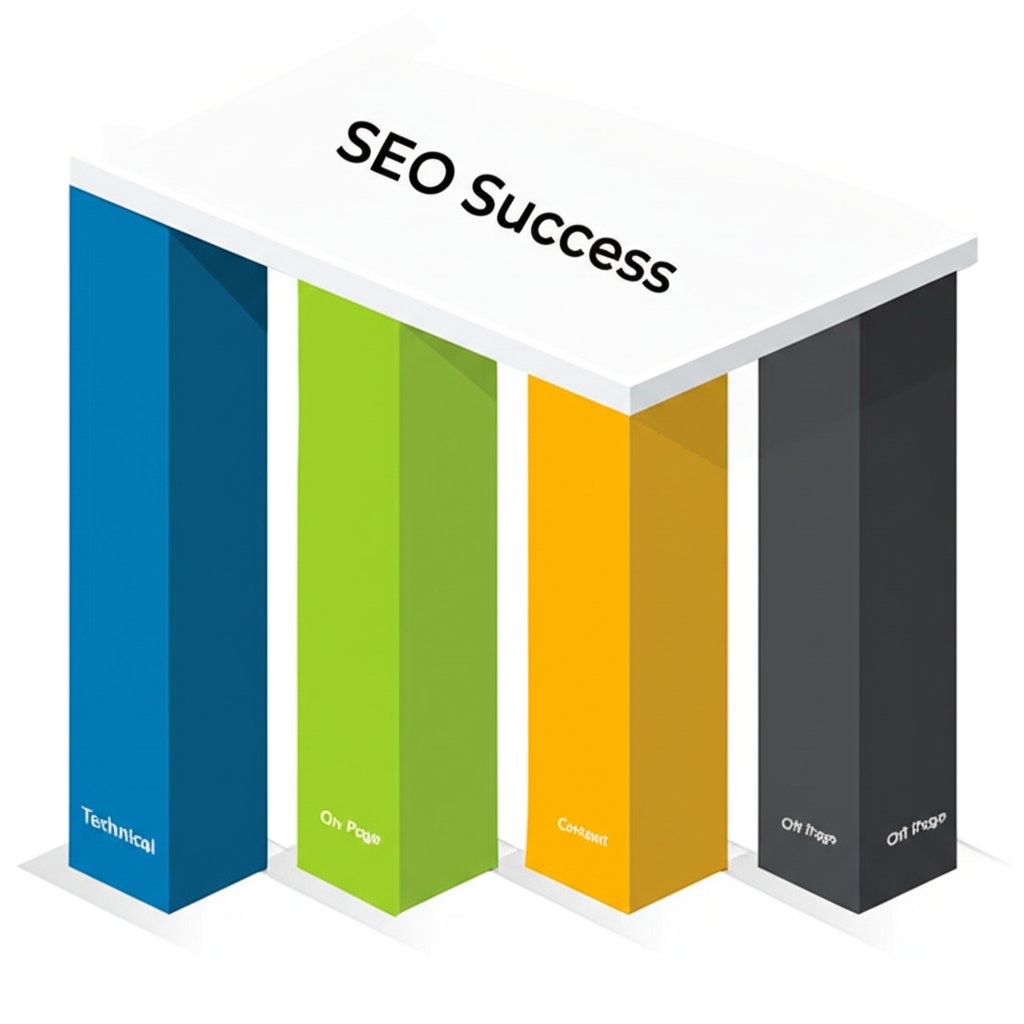
To structure your learning, it's helpful to break SEO down into four core pillars, a framework highlighted in resources from educational platforms like Coursera. These categories help organize the different activities you'll need to master: Technical SEO, On-Page SEO, Content, and Off-Page SEO. Understanding each one provides a clear path from foundational concepts to advanced strategies.
Technical SEO focuses on improving the infrastructure of your website to help search engine crawlers find, understand, and index your pages more effectively. The primary goal is to ensure your site is accessible and provides a good user experience. Key activities include ensuring your site is mobile-friendly, has a fast page speed, a logical site structure, and a clean XML sitemap that guides crawlers to your most important pages.
On-Page SEO involves optimizing the individual pages on your website to improve their relevance for specific keywords. This is often the most straightforward pillar to start with. It includes optimizing elements like title tags, meta descriptions, headings (H1, H2, etc.), and URL slugs. It also involves strategic use of internal links to guide users and search engines through your site and help them understand the relationship between your pages.
Content is arguably the most critical pillar. High-quality, relevant content is what satisfies user intent and earns you high rankings. This pillar focuses on creating valuable articles, blog posts, product pages, and other resources that answer your audience's questions. Google's E-E-A-T guidelines (Experience, Expertise, Authoritativeness, and Trust) are central here, emphasizing the need for well-researched, credible, and helpful information.
Off-Page SEO refers to actions taken outside of your own website to impact your rankings. This is primarily about building your site's authority and reputation, largely through acquiring backlinks. A backlink is a link from another website to yours, and search engines view them as votes of confidence. Building a strong backlink profile from reputable, relevant websites signals to Google that your site is a trustworthy source of information.
| Pillar of SEO | Primary Goal | Key Activities |
|---|---|---|
| Technical SEO | Improve site accessibility and user experience for crawlers and humans. | Page speed optimization, mobile-friendliness, XML sitemaps, site structure. |
| On-Page SEO | Increase page relevance for target keywords. | Title tags, meta descriptions, header optimization, internal linking. |
| Content | Provide value and satisfy user search intent. | Keyword research, creating helpful content, demonstrating E-E-A-T. |
| Off-Page SEO | Build website authority and trust. | Link building, digital PR, managing online reviews. |
Your Step-by-Step Roadmap to Learning SEO
Learning SEO can feel overwhelming, but following a structured roadmap makes the process manageable and effective. This step-by-step plan, inspired by guidance from industry leaders like Semrush, will take you from theory to practical application.
- Master Keyword ResearchKeyword research is the foundation of any successful SEO strategy. It's the process of discovering the words and phrases your target audience uses when searching for information, products, or services related to your niche. The goal is to find relevant terms with a reasonable search volume and manageable competition. Understanding user intent—what the searcher is truly looking for—is just as important as the keywords themselves.
- Learn to Create SEO-Optimized ContentOnce you have your keywords, the next step is to create content that targets them. This means writing articles, guides, or product pages that are not only informative and engaging but also structured for search engines. Focus on creating content that is genuinely useful and provides a better answer than what is currently ranking. As you scale your efforts, tools can help streamline this process. For instance, marketers and creators looking to increase their output without sacrificing quality often turn to platforms like BlogSpark, an AI blog post generator that helps transform ideas into SEO-optimized articles. By visiting https://blogspark.ai/, you can explore how AI aids in keyword discovery and content creation, ensuring a consistent brand voice.
- Get Hands-On with a Personal WebsiteTheory is important, but SEO is learned by doing. The single most effective way to learn is to create your own website or blog. This gives you a safe environment—a testing ground—to apply what you've learned without the pressure of working on a client's site. You can experiment with optimizing title tags, improving page speed, building internal links, and creating content. You'll make mistakes, but each one is a valuable learning opportunity.
- Understand Analytics and MeasurementYou can't improve what you don't measure. Setting up and learning to use free tools like Google Search Console and Google Analytics is non-negotiable. Google Search Console helps you monitor your site's performance in Google Search, showing you which keywords you rank for and if there are any technical issues. Google Analytics provides data on your website traffic and user behavior. These tools will tell you what's working and what isn't, allowing you to refine your strategy.
- Commit to Continuous LearningSEO is not a static field; it is constantly evolving. Google frequently updates its algorithms, and new technologies emerge. To stay effective, you must become a lifelong learner. Follow reputable industry blogs, subscribe to newsletters, and participate in online communities to keep up with the latest trends and best practices.
Essential Free Resources and Tools for Your Journey
One of the best parts about learning SEO is the abundance of high-quality, free resources provided by experts and search engines themselves. Instead of getting lost in a sea of information, focus on a few authoritative sources to build your foundation. This curated list will give you a reliable starting point and the essential tools you'll need to put your knowledge into practice.
To avoid information overload, start with these trusted resources:
- Official Documentation (Google): The best place to start is the source itself. The Google SEO Starter Guide provides fundamental best practices directly from the search engine you're trying to rank on. It covers the basics of how Google discovers, understands, and serves content.
- Comprehensive Learning Roadmaps: For a structured, all-encompassing guide, LearningSEO.io is an invaluable resource. It's a free roadmap that curates reliable guides, tools, and courses from across the web, covering everything from fundamentals to advanced specialization.
- Authoritative Industry Blogs: Blogs from major SEO tool providers are excellent for practical, data-driven advice. The blogs from Semrush and Mangools offer in-depth tutorials, case studies, and updates on the latest SEO trends. They break down complex topics into actionable steps for beginners.
Beyond reading, you'll need tools to analyze your site and track your progress. These two free tools from Google are essential for any website owner:
- Google Search Console: This is your direct line of communication with Google. It allows you to see how your site is performing in search results, submit sitemaps, identify crawl errors, and understand which queries are driving traffic to your site. Setting this up for your practice website should be one of your first steps.
- Google Analytics: While Search Console tells you what happens before a user clicks, Google Analytics tells you what happens after. It provides detailed insights into your website traffic, user demographics, behavior on your site, and conversion rates. Understanding how users interact with your content is crucial for improving your SEO strategy.

Frequently Asked Questions About Learning SEO
1. Can SEO be self-taught?
Yes, absolutely. With the vast amount of high-quality, free resources available online, including official guides from Google, comprehensive roadmaps, and expert blogs, it is entirely possible to teach yourself SEO. The key to success is combining theoretical learning with hands-on practice on a personal website to experiment and apply new concepts.
2. What is the 80/20 rule for SEO?
The 80/20 rule for SEO, also known as the Pareto Principle, suggests that approximately 80% of your organic traffic results will come from 20% of your efforts. For beginners, this means focusing on the highest-impact activities first. This often includes mastering keyword research to target the right audience, creating high-quality content that satisfies user intent, and ensuring your most important pages have strong on-page SEO and a few quality backlinks.


