

TL;DR
Making AI-generated text sound more human involves two primary approaches. You can use a dedicated AI humanizer tool, many of which are free, to automatically rewrite the content for a more natural flow and tone. Alternatively, you can manually edit the text by injecting personal voice, varying sentence length and structure, simplifying complex language, and using a more conversational style.
Understanding the 'Robotic' Signature of AI Text
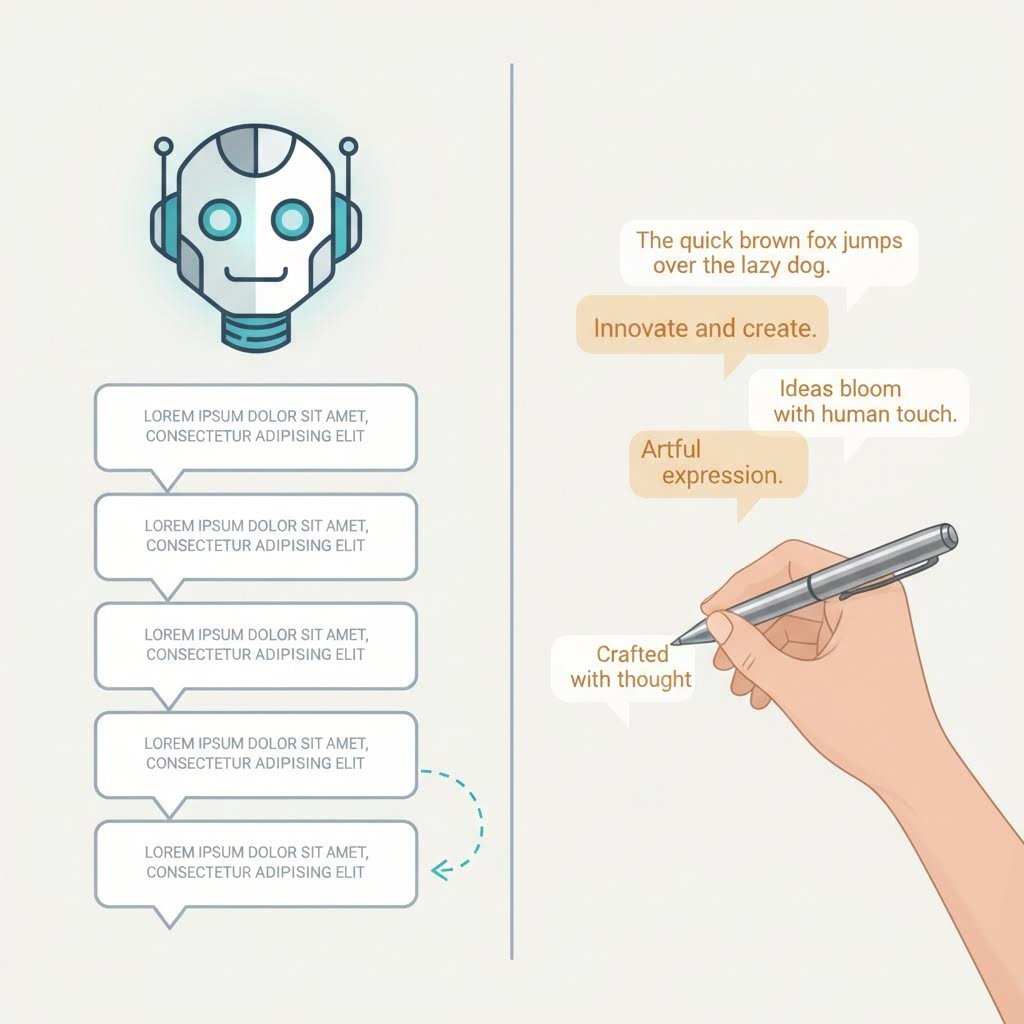
Have you ever read something and thought, "This was definitely written by a robot"? That feeling comes from what we can call the 'robotic signature' of AI-generated text. Early and unrefined AI models often produce content that, while grammatically correct, lacks the natural rhythm and nuance of human writing. This can manifest as an overly formal tone, repetitive sentence structures, awkward phrasing, and a general lack of personality that can make the text feel sterile and unengaging.
This robotic quality arises because AI models learn from vast datasets of text, identifying patterns and probabilities. However, they don't possess genuine understanding, emotion, or lived experience. The result is often writing that is predictable and lacks the subtle imperfections—like using contractions or varied sentence lengths—that make human communication feel authentic. When readers encounter this, it can create a disconnect, eroding trust and reducing the impact of your message.
Humanizing AI content is crucial for several reasons. Firstly, it dramatically improves reader engagement. Content that feels personal and relatable is more likely to hold a reader's attention and be persuasive. Secondly, it helps build trust with your audience. Authentic-sounding content is perceived as more credible. Finally, as AI detection tools become more common, raw AI text can be easily flagged. While the goal shouldn't be deception, refining AI output to meet quality standards is essential for professional and academic integrity.
Manual Techniques to Humanize AI-Generated Content
While automated tools are fast, manually editing AI-generated text gives you the ultimate control to infuse it with your unique voice and perspective. This hands-on approach is about more than just correcting errors; it's about transforming a generic draft into a compelling piece of content. For those looking to scale their content production, starting with a superior first draft from a more advanced platform can significantly reduce manual editing time. For instance, services like BlogSpark's AI blog writer are designed to create more nuanced and SEO-optimized articles from the start, providing a stronger foundation for your final touches.
Here are some essential manual techniques to make your AI writing more human:
- Inject Your Personal Voice and Stories: AI cannot replicate your personal experiences or unique perspective. Add short anecdotes, opinions, or examples from your own life or expertise. This is the fastest way to make content unique and build a connection with the reader. For example, change a generic sentence like "Exercise is beneficial for health" to "I've found that even a 15-minute walk in the morning completely changes my energy for the day."
- Vary Sentence Length and Structure: AI often defaults to medium-length, structurally similar sentences. Break this monotony. Mix short, punchy sentences with longer, more descriptive ones. This creates a rhythm that is more pleasing to read and helps emphasize key points. Read your text aloud; if it sounds monotonous, it's time to restructure your sentences.
- Use Contractions and Conversational Language: Unless you're writing a formal academic paper, use contractions like "you're," "it's," and "can't." This immediately makes the tone more approachable. Address the reader directly using "you" and replace overly formal words or jargon with simpler, everyday language. Think of it as writing for a person, not for a machine.
- Break Up Long Paragraphs: AI can generate dense blocks of text. For online reading, this is a major deterrent. Keep your paragraphs short, ideally 3-5 sentences each. Use white space to your advantage to make the content more scannable and less intimidating for the reader.
- Switch to the Active Voice: AI sometimes leans on the passive voice, which can make writing sound distant and weak (e.g., "The ball was hit by the boy"). The active voice is more direct and engaging ("The boy hit the ball"). Scan your document for passive constructions and rewrite them to be more dynamic and authoritative.
A Comparative Review of the Top AI Humanizer Tools
For those who need to refine AI text quickly, several powerful tools can automate the process. These AI humanizers analyze robotic-sounding text and rewrite it to be more natural and engaging. However, they operate with different features and philosophies. Here’s a comparison of some of the leading options available.
| Tool | Key Features | Best For | Pricing Model |
|---|---|---|---|
| Grammarly | Focuses on clarity and flow; includes transparency features like 'Authorship' to track AI use; integrated with a full suite of writing tools (plagiarism checker, citation generator). | Students and professionals who prioritize ethical AI use and writing integrity over bypassing detectors. | Free & Premium |
| QuillBot | Offers 'Basic' and 'Advanced' humanizing modes; Chrome extension works directly in ChatGPT; multi-language support. | Users who need flexibility and want to refine text in different languages or directly within their AI chat interface. | Free & Premium |
| Ahrefs | Simple, free tool integrated into a larger suite of powerful SEO tools; focuses on use cases like blogs, social media, and email marketing. | Marketers and SEOs who are already in the Ahrefs ecosystem and need a quick, no-frills humanizer. | Free |
| Surfer SEO | Explicitly designed to bypass AI detection tools; focuses on creating SEO-optimized content that ranks on Google. | Content creators whose primary goal is to avoid AI detection while maintaining SEO performance. | Free (with limits) & Premium |
Each tool offers a distinct approach. Grammarly stands out for its commitment to responsible AI use, providing features that help users cite and disclose AI assistance rather than just hide it. In contrast, tools like Surfer SEO and HumanizeAI.pro are marketed specifically for their ability to create "undetectable" content, appealing to users concerned about AI flags. QuillBot strikes a middle ground, offering powerful rewriting capabilities with features that enhance workflow efficiency, like its browser extension.
A Responsible Guide to AI Detectors and Undetectable AI
The rise of AI writing has led to the parallel development of AI detectors—tools designed to identify content generated by algorithms. This has created anxiety for many writers, leading to a search for "undetectable AI." However, the goal should not be to simply evade detection, but to produce high-quality, authentic, and ethical content. AI detectors typically look for patterns common in machine-generated text, such as low perplexity (predictable word choice) and burstiness (unvaried sentence structure).
Relying solely on bypassing these detectors is a risky strategy. First, AI detectors are not perfectly reliable and can produce false positives, flagging human-written text as AI-generated. Second, focusing on evasion overlooks the more important goal: improving the quality of the writing. The most sustainable approach is to use AI as an assistant, not a replacement. Use it to generate ideas, create outlines, or draft initial sections, but always apply the manual techniques discussed earlier to add your own expertise, voice, and factual verification.
Adopting a transparent and ethical workflow is the best practice. As platforms like Grammarly advocate, the focus should be on clarity and effective communication, not deception. If you are a student or professional, always be aware of your institution's or organization's policies on AI-generated content. When in doubt, it is always better to disclose your use of AI tools. This builds trust and ensures you maintain academic and professional integrity while still benefiting from the efficiency that AI offers.
Frequently Asked Questions
1. How to make AI write like a human free?
You can make AI write like a human for free using several methods. The most effective free approach is manual editing: take the AI-generated draft and apply techniques like using the active voice, adding personal stories, varying sentence length, breaking up long paragraphs, and replacing jargon with simpler words. Additionally, many of the top AI humanizer tools, including those from Grammarly, QuillBot, and Ahrefs, offer free versions that can instantly rewrite text to sound more natural.